
财经郎眼
US watchdog says Taliban benefiting from international aid through 'fraudulent' NGOs_我的网站

一 |
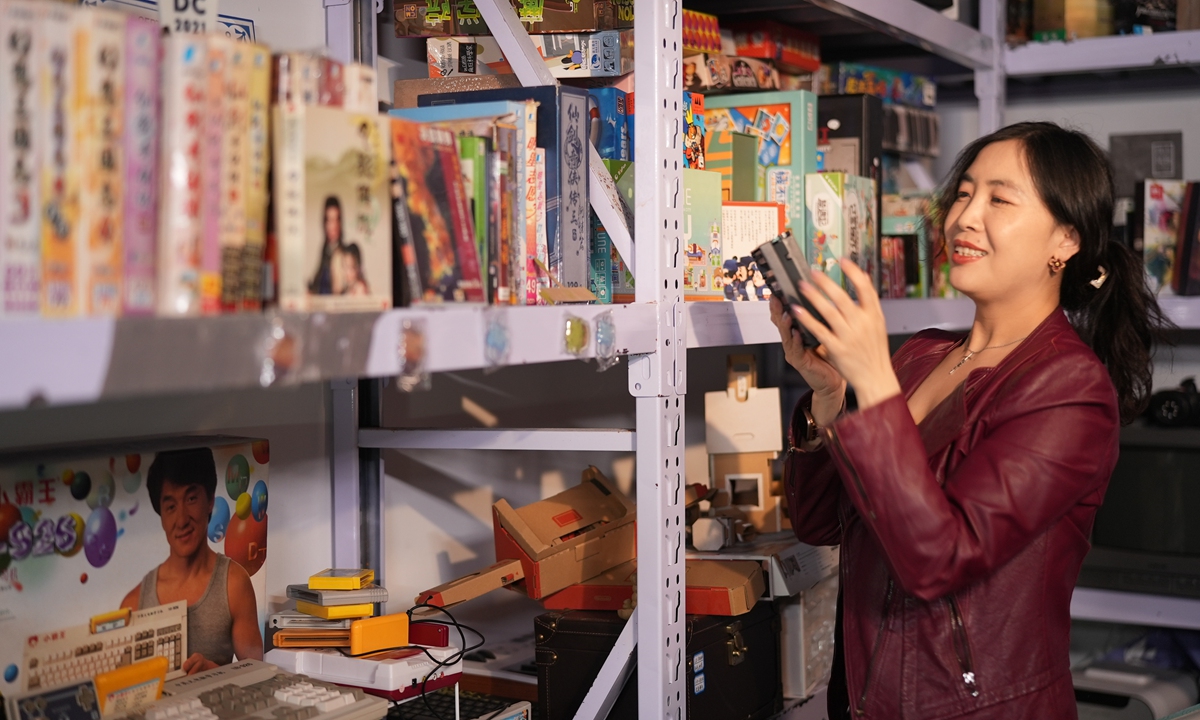
Inside Beijing's Homoludens Archive, shelves are filled with books, game consoles, game cartridges and other materials tracing the history of video games. For Liu Mengfei, the archive's director and chair of the academic committee of the Gamification Professional Committee, these collections preserve more than the evolution of games, they also capture the cultural memories of a generation.
A PhD in history from Tsinghua University, Liu has spent more than a decade studying the social impact of games, the role of games in history and digital humanities. Throughout her career, she has continued to explore the relationship between games and people: Why do humans create games? And how do games shape culture and society?
Books, meanwhile, have been an important gateway through which Liu has come to understand the world of games.
"The real value of a book lies not simply in what it tells you, but in whether it can change the way you understand the world and people," Liu told the Global Times.
Books meet games
In 2007, being an undergraduate history student, Liu wrote her thesis on the links between ancient Celtic religion and modern digital games.
To study original sources such as The Gallic War by Roman author Julius Caesar, she taught herself Latin. As her research extended into modern games, she also began reading the rulebooks of Dungeons & Dragons, a tabletop role-playing game.
"From historical texts to game rulebooks, these reading experiences seemed to belong to completely different worlds, but they gradually led me to realize that games are not simply entertainment products. They also contain history, culture and the relationships between people and society," she said.
Later, Homo Ludens, by Dutch historian Johan Huizinga, further transformed the way she understood games. The book gives a theory that humans are not only Homo sapiens, or "rational beings," but also Homo ludens, or "playing beings," and that games are deeply intertwined with human culture, from language and art to religious rituals and sports.
The book had a profound influence on her. It points out that the foundations of human society — language, civilization, religious rituals, sports and art, are all connected to play and games, because we are Homo ludens, "the playing human."
"The idea prompted me to view games from a broader perspective," Liu said. "Games are not an appendage outside human civilization, but are deeply connected to cultural creation and social life."
"It also showed me that games and game-based thinking could extend into broader fields, including education and technology," she added.
She later read other works on game studies, including Play Between Worlds: Exploring Online Game Culture, Half-Real and Rules of Play Game Design Fundamentals. Play Between Worlds, in particular, opened up another possibility for game studies at a time when discussions about "internet addiction" were prevalent in China.
"Games are not simply a form of entertainment that needs to be restricted or criticize;. they can also serve as important media for storytelling, cultural expression and exploring relationships," she said.
These reading experiences gradually shifted Liu's focus from simply asking "What are games?" to a deeper question: What can games bring to people?
Beyond time and technology
Periodically, Liu still returns to Homo Ludens in her free time, finding new insights from the book as society changes. In the age of artificial intelligence, she has revisited one of its fundamental questions: As AI becomes increasingly capable of handling repetitive tasks and surpasses humans in efficiency, what does it mean to be human?
"As AI takes over more monotonous and repetitive work, the time freed up should be devoted to creativity, experience and human relationships," she said. "The time we gain should actually be used to become better at 'playing humans.'"
For Liu, this also requires people to maintain their ability to think, imagine and reflect -- abilities that cannot be gained through simply receiving information. This has also prompted her to reconsider the meaning of reading.
In an era when AI can quickly summarize an entire book, Liu believes people still need to read the original works in full, because the value of reading lies in more than simply acquiring knowledge and conclusions.
"Reading a book is like a form of cultivation. You have to immerse yourself in it, patiently allow the author to take you on a journey, and find your own island along the way," she said.
For Liu, the value of reading is not limited to books on paper. As media evolve, so do the ways people encounter stories and understand culture. Some digital works are now becoming new vehicles for reading.
Chinese-developed games such as Genshin Impact contain hundreds of thousands, and even more than a million Chinese characters of text, while Black Myth: Wukong uses its "Journal" system to tell the stories of individual monsters through written entries.
"Digital games are carrying forward traditions inherited from literature and film, becoming new gateways, through which young people can enter the worlds of literature, history and traditional culture," she said.
"An important reason why Black Myth: Wukong has succeeded in communicating Chinese culture is that it does not simply insert traditional cultural symbols into a game. Instead, it draws on the original Journey to the West, contemporary works inspired by the classic, as well as the game's own rules and interactions, allowing players to develop a new understanding of traditional culture through their actions," she noted.
For Liu, the forms of reading may change, but the desire to understand the world and discover oneself will not. From books to digital worlds, what matters is not only what people read or play, but how they think, create and find meaning through these experiences.
。 KABUL, Afghanistan -- The watchdog for U.S. assistance to Afghanistan has warned that the Taliban are benefiting from international aid through the establishment of fraudulent nongovernmental organizations.The Taliban have exerted greater control over national and international NGOs since seizing power in August 2021. They have barred Afghan women from NGO work and sought to push out foreign organizations from the education sector.A report from the U.S. Special Inspector General for Afghanistan Reconstruction, or SIGAR, said it found that the Taliban benefit from American-funded education programming through the generation of tax revenues and from more “nefarious” methods like the establishment of fraudulent NGOs and extorting and infiltrating existing NGOs to obtain or direct international donor aid. In May, a SIGAR report highlighted the Taliban’s interference with NGO work in Afghanistan. The Ministry of Economy, which supervises the sector, rejected the claims. Ministry spokesman Abdul Rahman Habib, responding to the latest SIGAR report on Monday, said there was no evidence of interference.According to the report, published this month, the U.S. has spent around $185 million on education in Afghanistan since August 2021.An NGO official told SIGAR that the Taliban target and extort Afghans who receive monetary support from American-funded education programs under the guise of taxation. In another example, NGO officials told the watchdog that the Taliban coerced NGOs into hiring supporters or purchasing goods from Taliban-owned companies.Taliban policies and priorities have reduced the overall quality of education, with a drop in the number of teachers and a decrease in teacher quality, as unqualified community members or Taliban officials replace staff, SIGAR said."We found that the Taliban have been unable to fully fund public school teacher salaries and building maintenance costs, leading to further teacher shortages and the deterioration of school buildings."The redirection of international donor aid to community-based education schools, along with financial and infrastructure challenges facing the Taliban, raised serious questions about how the Taliban could sustain the education sector and if they had any intention of doing so, the report said.An Education Ministry spokesman, Qari Mansor Ahmad Hamza, called the SIGAR report baseless and said the quality of teaching and school facilities in Afghanistan is better than before.“At present, the projects and financial assistance of international aid agencies are under the strong supervision of the top leadership of the Islamic Emirate of Afghanistan,” Hamza said, employing the term the Taliban use to describe their administration. The leadership promises to “invest this aid” and share reports with the country, the spokesman added.。

二 |
Current article:http://ypvpj7.tandianxiuzhutiaoshoudiamei.pics/fzphlpp/5vmh.html
Published on:19:31:01


